
Sewer Pipe Lining vs. Replacement: A Homeowner’s Guide to Choosing the Right Repair
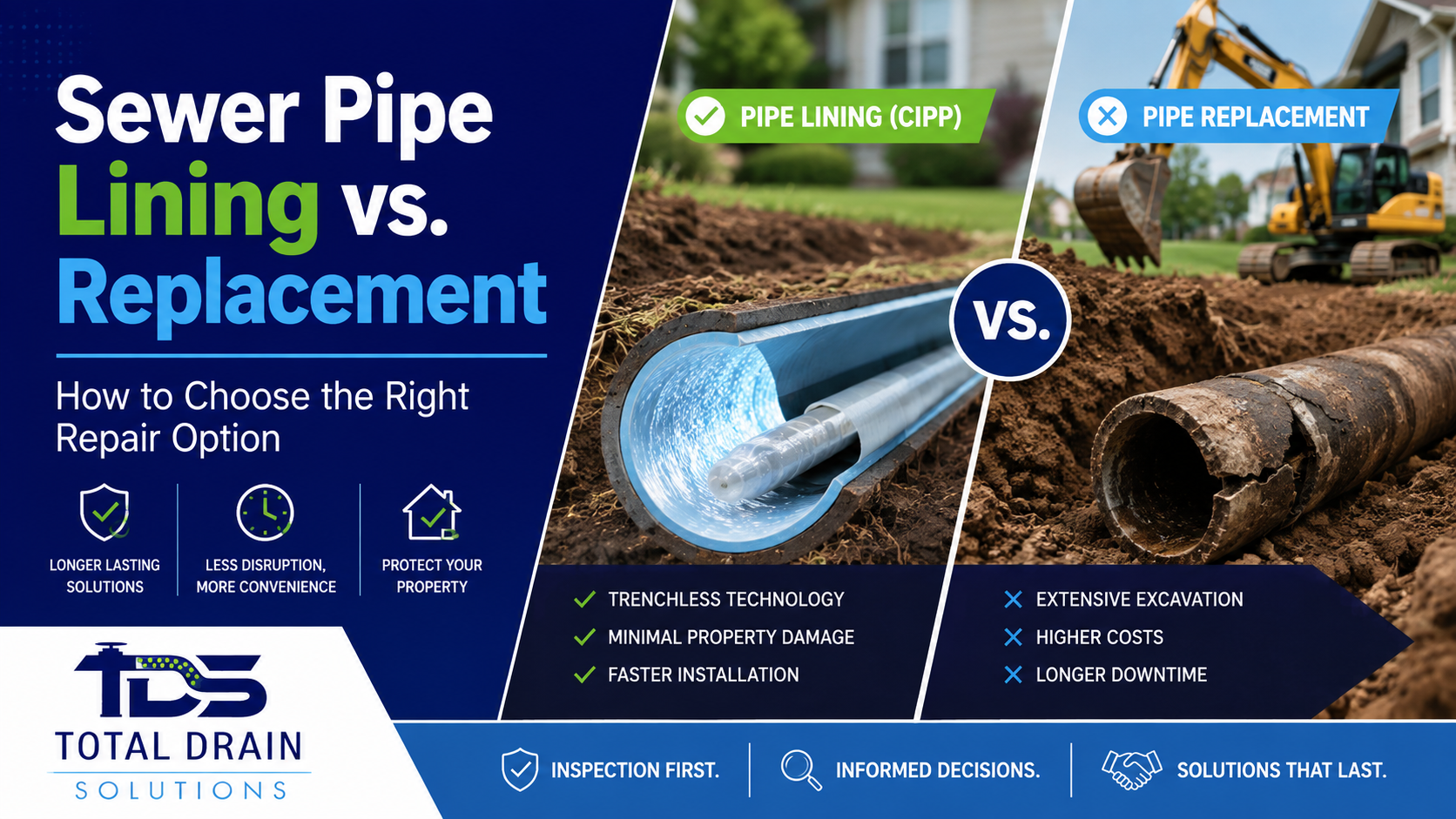
A sewer failure can quickly turn into one of the most disruptive problems a property owner faces. Recurring clogs, sewage backups, slow drains, odors, and suspected underground damage can create pressure to approve a major repair quickly. But the most expensive recommendation is not automatically the right one—and neither is the least invasive option.
At Total Drain Solutions, our approach is to inspect first, document what the pipe is actually showing, and then compare the repair paths that make sense for that condition. Our drain and pipe rehabilitation team works across residential, commercial, condo, HOA, multifamily, hospitality, and other complex properties, where the cost of choosing the wrong repair method can be significant.
This guide is designed to help you move beyond a simple “repair or replace” decision. Depending on the findings, the right next step may be professional cleaning, a localized repair, trenchless pipe lining, partial replacement, or full replacement. You can also explore our broader sewer and drain services and service areas if you need location-specific support.
Understanding the Sewer Problem: Detection and Diagnosis
Common Signs of a Building Sewer Lateral Problem
When a sewer system begins to fail, the symptoms are often difficult to ignore. Slow-draining fixtures, gurgling sounds, recurring clogs, foul sewer odors, or backups in floor drains can point to a problem deeper in the drainage system. Outdoors, unusually wet soil, persistent soft spots, or unexplained changes in vegetation near a sewer route may justify further investigation. The U.S. Environmental Protection Agency notes that blockages, line breaks, and sewer defects are among the causes associated with sanitary sewer overflows and backups. Review the EPA’s sanitary sewer overflow guidance.
Those warning signs do not tell you, by themselves, whether the pipe should be cleaned, patched, lined, or replaced. They tell you that the system deserves a closer look. For isolated or recurring blockage symptoms, our professional drain cleaning services may be one part of the diagnostic and maintenance process.
Why the Root Cause Matters
Pipes can deteriorate for many reasons. Aging cast iron may corrode and scale internally. Clay or older jointed piping can shift over time. Tree roots can enter through defects or joints. Soil movement may contribute to offsets or structural damage. Grease, sludge, mineral scale, and debris can also create flow restrictions that feel like a structural failure even when the pipe itself may still be serviceable.
This is why Total Drain Solutions does not treat every recurring clog as proof that a sewer line needs structural rehabilitation. Depending on what we find, pipe cleaning, mechanical cleaning, or hydro jetting may be appropriate before a major repair is considered.
When to Call a Professional Drain and Sewer Team
If problems keep returning after basic clearing, or if multiple fixtures are affected, it is usually time to move beyond temporary troubleshooting. Chemical drain cleaners and aggressive DIY methods can mask symptoms without explaining the underlying condition. A professional evaluation can help distinguish between buildup, a localized defect, and broader structural deterioration.
For homeowners, our residential drain and sewer services are designed around diagnosis before unnecessary repair. For larger buildings and facility systems, our commercial drain and sewer services support more complex inspection, maintenance, and rehabilitation planning.
The Diagnostic Foundation: Sewer Camera Inspection
How Technicians Use Camera Inspections to Assess Damage
A professional sewer camera inspection uses video equipment to document the condition inside an accessible drain or sewer line. The purpose is not merely to produce footage; it is to identify the location, type, and extent of visible conditions so the repair recommendation can be tied to evidence.
Industry organizations also emphasize structured inspection and condition assessment. NASSCO’s Building Sewer & Drain Inspection program is specifically designed around proper inspection and assessment of private building sewers and drains. Learn about NASSCO’s building sewer inspection framework.
What the Camera Findings Can Reveal
Depending on access, visibility, cleaning status, and pipe condition, camera footage may help document blockages, root intrusion, corrosion, cracks, joint displacement, deformed sections, bellies, or collapsed areas. At Total Drain Solutions, we want the footage to answer practical questions: Is the damage isolated or continuous? Has the pipe generally maintained its shape? Is cleaning needed before the line can be evaluated properly? Does the defect appear suitable for localized repair, lining, or replacement?
If you want more background on the inspection process itself, see our guide to what happens during a sewer camera inspection and our article on common issues revealed by sewer cameras.
Interpreting the Results: Clean, Spot Repair, Line, or Replace?
A useful inspection should move the conversation from “something is wrong” to “here are the reasonable options.” One localized defect may justify a targeted repair. Widespread deterioration in a pipe that remains suitable for rehabilitation may support CIPP lining. A severe collapse, major displacement, or grade problem may make excavation or replacement the better route. Heavy buildup without major visible structural failure may point back toward cleaning.
The goal is to match the scope of work to the condition of the line—not to force every project into one preferred repair product. This same inspection-first philosophy is built into our trenchless sewer repair services.
Option 1: Cleaning When the Pipe Does Not Need Structural Repair
Not every recurring backup means the sewer line needs to be lined or replaced. Grease, sludge, mineral scale, hardened debris, and certain root-related obstructions can restrict flow inside a pipe that may still be structurally serviceable. In those situations, cleaning can be a more appropriate first step.
High-pressure hydro jetting can remove buildup from suitable lines, while specialized mechanical cleaning may be useful when hardened scale or difficult deposits require physical removal. Cleaning can also be necessary before a final camera evaluation or before a pipe is prepared for rehabilitation.
Option 2: Spot or Sectional Sewer Repair
A spot repair may make sense when the defect is limited to a relatively short portion of an otherwise serviceable system. Examples can include an isolated break, a localized joint issue, or a short damaged section where a full-length rehabilitation would be unnecessarily broad.
There is more than one way to approach localized rehabilitation. NASSCO’s current pipeline rehabilitation guidance includes CIPP spot-repair systems among the technologies used for localized pipe defects. See NASSCO’s pipeline rehabilitation matrix for a broader comparison of rehabilitation methods and their limitations.
The important point is that “spot repair” is not a universal technique or guarantee. Access, pipe material, defect geometry, location, grade, structural condition, and nearby connections can all affect what is feasible. A targeted repair should be recommended because the defect is localized—not simply because it sounds less expensive.
Option 3: Sewer Pipe Lining (CIPP)
What Is Sewer Pipe Lining?
Cured-in-place pipe, commonly called CIPP, is a trenchless rehabilitation method that creates a new liner within an existing pipe. A resin-saturated liner is installed into the host pipe and cured in place, creating a close-fitting inner pipe. NASSCO describes CIPP as a widely used trenchless technology for localized repairs as well as longer pipeline segments. Review NASSCO’s pipe rehabilitation overview.
For a detailed look at how the process is completed, Total Drain Solutions has a separate CIPP pipe lining step-by-step guide. Keeping the process explanation on that dedicated resource helps this article stay focused on the more important decision: when lining is appropriate compared with spot repair or replacement.
How CIPP Can Reduce Property Disruption
When the existing pipe is a good candidate for lining, CIPP may allow rehabilitation through existing or limited access points rather than exposing the entire pipe run. That can be particularly valuable when sewer lines pass under finished flooring, landscaping, sidewalks, driveways, parking areas, or occupied commercial spaces.
Total Drain Solutions evaluates the existing line before recommending lining because the host pipe still matters. Preparation can include cleaning and inspection, and project requirements vary by diameter, access, defects, configuration, and the selected system.
When Sewer Pipe Lining May Be a Good Fit
Pipe lining may be considered when the line has deterioration such as cracking, corrosion, leaks, or root-related defects but still retains enough configuration for the selected lining system. It can be especially attractive when a longer section needs rehabilitation and open excavation would create significant restoration or operational disruption.
Our main CIPP and trenchless pipe lining page explains candidate conditions, preparation, and the relationship between inspection, cleaning, and lining.
Limitations: When Lining Is Not the Right Substitute for Replacement
Lining is not a cure-all. CIPP follows the existing route and grade of the host pipe. NASSCO’s rehabilitation matrix notes that the existing line and grade remain, and that crushed or collapsed pipe and significant cross-sectional restrictions can prevent proper liner installation. That means severe collapse, major deformation, or grade-related problems may require a different approach.
Similarly, a badly displaced or unstable section may need targeted excavation or replacement rather than simply covering the problem from the inside. This is one reason a qualified assessment matters more than a “no-dig at all costs” sales pitch.
Option 4: Traditional or Targeted Sewer Pipe Replacement
The Conventional Method: Excavation and Trenching
Traditional sewer replacement exposes the failed pipe so it can be removed or bypassed and a new section installed. Depending on the project, replacement can provide an opportunity to correct structural conditions that lining cannot change, such as certain grade, alignment, or severely damaged pipe conditions.
Excavation is also a substantial construction activity with important safety requirements. The Occupational Safety and Health Administration maintains specific standards and guidance for trenching and excavation work. Read OSHA’s trenching and excavation overview.
When Replacement May Be Necessary
Replacement may be the responsible choice when the pipe is severely collapsed, missing, crushed, unstable, or otherwise unsuitable for rehabilitation. It may also be required when the real problem is the physical alignment or grade of the line rather than simply deterioration of the pipe wall.
That does not mean every belly, offset, or damaged joint automatically requires full replacement. The scope should match the severity and extent of the problem. In some systems, a targeted replacement of one section may be more appropriate than excavating the entire lateral.
Correcting Pipe Slope, Grade, and Major Alignment Problems
One of replacement’s key advantages is physical access to the pipe bed. If the underlying issue requires regrading or repositioning the line, excavation may allow the contractor to correct conditions that a liner cannot change. A liner is installed within the path of the host pipe; it does not automatically redesign the slope of that sewer run.
A System Reset—When the Conditions Justify It
When deterioration is extensive enough that rehabilitation is not appropriate, replacement can provide a new pipe section rather than relying on the remaining host pipe. The value of that reset depends on proper design, installation, bedding, connections, local code requirements, and site conditions—not simply on the fact that the material is new.
Sewer Pipe Lining vs. Spot Repair vs. Replacement: Decision Matrix
| Factor | Spot / Sectional Repair | Pipe Lining / CIPP | Replacement |
|---|---|---|---|
| Best suited for | Localized defects in a limited section | Longer sections that remain suitable for rehabilitation | Severe structural failure or conditions rehabilitation cannot correct |
| Existing pipe remains in place | Usually, except where a section is physically replaced | Yes | No, for the replaced section |
| Excavation | Varies by repair method and access | Often limited compared with full open-trench replacement | Often greater, depending on method and site |
| Surface disruption | Usually localized | Often reduced | Can be significant |
| Long sections of deterioration | Usually not the primary use case | Often a strong use case when the host pipe is suitable | Can address long sections when replacement is justified |
| Corrects serious grade or alignment problems | Sometimes, if the affected section is replaced or reconstructed | Generally no; lining follows existing line and grade | Can, when excavation allows the line to be reset |
| Camera inspection role | Helps localize the defect and plan scope | Critical for determining suitability and documenting preparation | Helps confirm why replacement is necessary and how much line is affected |
| Where reduced disruption matters | Useful for isolated repairs near finished areas | Especially valuable under slabs, landscaping, driveways, parking areas, and occupied properties | May still be necessary even when disruption is inconvenient |
Cost Analysis: Upfront Price vs. Total Project Cost
Price should be evaluated in the context of the entire project. Lining may reduce excavation and restoration costs when the existing line is a good candidate. Spot repair may prevent unnecessary work on healthy sections. Replacement may cost more upfront but can be the better investment when structural conditions cannot be corrected with rehabilitation.
Be cautious with any quote that makes cost the only decision factor. Ask what the camera footage shows, how much pipe is affected, what surface restoration is included, what preparation is required, and what conditions could change the scope after work begins.
Durability and Long-Term Performance
There is no responsible way to declare one method universally “more durable” without considering the system. Long-term performance depends on the pipe condition, selected materials, engineering or design requirements where applicable, installation quality, surrounding soil, connections, maintenance, and how the system is used.
For lining projects, quality control matters as much as the basic technology. For replacement, bedding, grade, joints, and installation quality matter just as much as the new pipe material. Ask the contractor to explain what performance expectations are supported for the specific system being proposed.
Project Duration and Operational Disruption
Trenchless lining is often completed with less excavation and site restoration than open-trench replacement, which can shorten the disruptive portion of many projects. But actual duration varies widely based on cleaning requirements, access, liner length, curing method, permitting, bypass needs, excavation, inspection, and site restoration.
For condos, commercial properties, restaurants, hotels, healthcare facilities, and multifamily buildings, the best method may be the one that balances structural needs with tenant, resident, and operational constraints—not simply the fastest technique.
Environmental and Site-Impact Considerations
Reducing excavation can also reduce the amount of landscaping, paving, concrete, flooring, and other finished materials that must be disturbed and restored. That can mean less construction debris and fewer site impacts on qualifying trenchless projects. However, the environmental and logistical profile of each project depends on access, bypass requirements, equipment, material selection, and disposal needs.
Financial Realities: Insurance, Warranties, and Property Records
Insurance: Do Not Assume a Sewer Repair Is Covered
Insurance terms vary significantly by policy and by cause of loss. The National Association of Insurance Commissioners lists sewer or drain backup coverage as an optional homeowners coverage in many cases, which is different from assuming that deterioration or the sewer line repair itself is covered. Review the NAIC’s homeowners insurance guidance and speak directly with your insurer or licensed insurance professional about your policy.
If a claim or insurance discussion is involved, retain the camera footage, inspection report, estimate, photographs, repair scope, invoices, and any post-repair inspection documentation. Those records can help establish what was found and what work was performed.
Actual Cash Value, Replacement Cost, and Policy Language
Terms such as actual cash value and replacement cost can affect how covered property losses are settled, but sewer-line coverage is policy-specific. Do not assume the phrase “replacement cost” automatically means your underground service line will be replaced at no cost. Ask your insurer what peril is covered, which portion of the property is insured, what deductible applies, whether service-line or water-backup endorsements exist, and what documentation is required.
Warranty Service: Get the Details in Writing
Whether you are considering lining, a sectional repair, or replacement, ask for the written warranty terms before approving work. Confirm what is covered, how long coverage lasts, who is responsible for warranty service, what maintenance requirements apply, and which conditions are excluded. A warranty should be evaluated alongside the inspection findings and repair design—not used as a substitute for them.
Property Resale and Maintenance Records
Documented sewer work can reduce uncertainty for future owners, property managers, lenders, boards, or facility teams. Keep before-and-after inspection footage, reports, invoices, warranty documents, permits where applicable, and maintenance records together. For commercial and multifamily systems, our guide to CCTV sewer inspection planning for commercial properties explains how documentation can support long-term maintenance decisions.
Questions to Ask Before Approving Sewer Repair
- Can you show me the problem on the camera footage?
- Is the damage isolated or spread throughout the line?
- Why are you recommending this repair method?
- Could a targeted repair address the damaged section?
- Is the existing pipe actually a suitable candidate for lining?
- Are there collapsed, badly displaced, or severely deteriorated sections?
- Could cleaning or monitoring be sufficient at this stage?
- Which work is necessary now, and which work could potentially be phased?
- What alternatives should I consider?
- What specific finding would change the recommendation from lining to replacement?
When a Second Opinion Makes Sense
A second opinion can be valuable when you have been told that the entire sewer line needs replacement, when a full-length lining project has been proposed, when excavation would be extensive, or when a condo, HOA, commercial property, or multifamily building is considering a large rehabilitation budget.
At Total Drain Solutions, the purpose of a second opinion is not to prove another contractor wrong. It is to compare the proposed scope with the visible condition of the system. Our inspection-first diagnostic process can help determine whether cleaning, monitoring, a sectional repair, CIPP lining, targeted replacement, or a broader replacement should be considered.
That method-neutral approach is especially useful when multiple repair paths are technically possible. Sometimes the right answer is the least disruptive option. Sometimes it is a targeted excavation. Sometimes replacement is the responsible decision. The evidence should lead the recommendation.
Choosing the Right Method for Your Property
Choosing between sewer pipe lining and replacement comes down to more than the age of the pipe or the size of the quote. The condition of the line, the length and severity of the damage, access, grade, pipe material, surface restoration, building operations, and long-term goals all matter.
If the pipe is substantially intact but deteriorated, lining may provide a practical rehabilitation path. If only one area has failed, a localized repair may be enough. If the pipe has major structural, alignment, or grade problems, replacement may be the better investment. And if the real issue is buildup rather than structural failure, cleaning may be the correct first move.
Total Drain Solutions provides specialized inspection, cleaning, pipe lining, and sewer rehabilitation throughout key markets in Florida and Nevada. Property owners can learn more about our Florida sewer and drain services, Sarasota drain and sewer solutions, Las Vegas pipe and drain services, and our growing Tampa pipe restoration services.
For local decision-stage support, we also provide camera inspections in Sarasota, Sarasota CIPP pipe lining, and trenchless sewer repair in Sarasota. In Southern Nevada, property owners can review our Las Vegas sewer camera inspection, Las Vegas trenchless pipe lining, and Las Vegas trenchless sewer repair pages.
Conclusion: Inspect First, Then Choose the Repair
Navigating a sewer failure requires technical information, practical judgment, and a clear view of the tradeoffs. The inspection report and camera footage should be the starting point—not the sales pitch. Once the condition of the pipe is understood, you can compare cleaning, spot repair, lining, partial replacement, and full replacement with much greater confidence.
Total Drain Solutions believes property owners should be able to see the evidence behind a major sewer recommendation. If you already have a sewer repair or pipe lining estimate and want another perspective, contact Total Drain Solutions to schedule an inspection or second-opinion evaluation. We will help you understand what the line is showing and which repair paths deserve consideration.
Looking for pipe repair options in Tampa Bay? Total Drain Solutions provides inspection-led pipe lining and trenchless sewer repair in Tampa, pipe lining and sewer repair in Clearwater, and specialized trenchless pipe repair in St. Petersburg. Our team evaluates the condition of the existing pipe first so property owners can compare cleaning, targeted repair, lining, and replacement based on the actual system rather than assuming one method is right for every project.
Related Posts
- CIPP Pipe Lining: The Step-by-Step Process
- What Happens During a Sewer Camera Inspection?
- Typical Challenges Revealed in Sewer Camera Inspections
- CCTV Sewer Inspection Costs: A Commercial Property Owner’s Guide
FAQ: Sewer Pipe Lining vs. Replacement
Sewer pipe relining can be worthwhile when the existing pipe is still suitable for rehabilitation and the main problem is deterioration, cracking, corrosion, or similar damage that does not require the line to be physically regraded or reconstructed. CIPP lining can reduce excavation and surface disruption, but it is not automatically the right solution for every sewer problem. A camera inspection and proper evaluation should determine whether lining, spot repair, cleaning, or replacement makes the most sense.
Pipe relining may be considered when an inspection shows deterioration along a section of pipe that still maintains enough shape and alignment for rehabilitation. Conditions such as corrosion, cracking, leaks, or root-related defects may make a pipe a candidate for lining. If the damage is isolated, a spot repair may be more appropriate, while severe collapse, displacement, or grade problems may require replacement. The decision should be based on the actual condition of the pipe rather than the repair method alone.
Replacement may need to be considered when the sewer line has severe structural failure that cannot be corrected by lining or a localized repair. Examples may include collapsed or crushed sections, significant displacement, major alignment problems, or grade issues that require the pipe to be physically repositioned. Not every damaged sewer line requires full replacement, which is why documenting the location and extent of the problem through inspection is an important first step.
CIPP lining cannot correct every type of sewer-line problem. Because the liner generally follows the existing route and grade of the host pipe, it may not solve significant bellies, severe misalignment, major deformation, or collapsed sections. The existing pipe also has to be properly evaluated and prepared before lining. For the right candidate, CIPP can significantly reduce excavation, but its limitations should be explained clearly before a property owner commits to the repair.
Trenchless sewer repair can reduce costs associated with excavation and restoring landscaping, concrete, flooring, parking areas, or other finished surfaces, but it is not automatically less expensive in every situation. Project cost depends on the pipe condition, length of repair, access, cleaning and preparation requirements, repair method, and site conditions. The better comparison is the total scope and long-term suitability of each option rather than price alone.
Tags:
Schedule Service
Our Services

Benefit From Our Complete Range of Services Today
At Total Drain Solutions, we get the work done right the first time. Each member of our team works with the highest level of integrity. By using the best technology and processes along with proven craftsmanship, we fully restore your piping system to its original condition. For more information or to get an estimate, contact our team today.