
Why Does My House Smell Like Sewer? A Room-by-Room Guide to Finding the Source
A sewer smell inside a home is one of the more unsettling plumbing problems a property owner can run into. It is hard to ignore, it tends to come and go, and it is easy to misdiagnose. Some causes take five minutes to fix. Others point to a cracked or corroded drain line that has been leaking under a slab for years. The smell alone does not tell you which one you have.
At Total Drain Solutions, our approach to odor complaints is the same as our approach to any drain or sewer problem: find the actual source first, document it, and then match the fix to what the system is showing. Our drain and pipe rehabilitation team works on single-family homes, condos, multifamily buildings, and commercial properties, and sewer odor is one of the most common reasons people call us.
This guide walks through the causes of a sewer smell in the house, from the simplest to the most serious, and explains how to narrow down where it is coming from before anyone opens a wall or a floor. Depending on what you find, the right next step may be a bucket of water, a professional drain cleaning, or a sewer camera inspection of the line itself. You can also browse our full range of drain and sewer services or find your local service area.
First, a Word on Safety
Sewer gas is a mix of gases produced as wastewater breaks down. The one you smell is hydrogen sulfide, which has a rotten-egg odor at very low concentrations. Methane is also present and has no smell at all. The National Institute for Occupational Safety and Health documents the health effects of hydrogen sulfide in its pocket guide to chemical hazards: at low levels it can cause headaches, nausea, and eye and throat irritation, and at higher levels it can dull your sense of smell. That last point matters. A sewer odor that fades after a few minutes is not proof the problem went away.
Two other points before you start investigating. First, natural gas is odorless but is treated with a rotten-egg additive so leaks can be detected, which means a gas leak and a sewer leak can smell similar. If the odor is strong, is concentrated near a gas appliance or gas line, or is accompanied by a hissing sound, leave the building and call your gas utility from outside. Second, if the smell is strong enough to cause dizziness or nausea, ventilate the space and step outside before you do anything else. Residential sewer gas concentrations are usually low, but the goal is to find the source, not to test your tolerance.
How to Narrow Down a Sewer Smell Before You Call Anyone
Most sewer odor calls we take could be narrowed down a great deal by answering three questions. Doing this first saves diagnostic time and sometimes solves the problem outright.
Where Is the Smell Strongest?
Walk the house with your nose. Note whether the smell is confined to one bathroom, one floor, the laundry room, the garage, or the whole house. Get close to each fixture: the sink overflow hole, the shower drain, the base of the toilet, the floor drain, the washing machine standpipe. A smell that is strongest at one drain is a different problem than a smell that seems to come from everywhere. A smell that is strongest outside, near the foundation or in the yard, points to the sewer lateral or a cleanout rather than the interior plumbing.
When Does It Happen?
Timing is the most underrated clue in odor diagnosis. Ask yourself:
- Does the smell appear only when a specific fixture is running or draining?
- Does it show up when the air conditioning cycles on, or when a bathroom exhaust fan runs?
- Is it worse after heavy rain, or during the hottest, driest weeks of the year?
- Does it come from the hot water tap only?
- Did it start after a period when the house sat empty, or after a plumbing repair, a renovation, or a new fixture installation?
Each of those patterns points toward a different cause, which we cover below.
Is Anything Else Going On?
A sewer odor rarely travels alone when the cause is inside the pipe. Look for gurgling from toilets or drains when other fixtures run, slow drains in more than one room, a toilet that rocks or that has water seeping at the base, a damp or discolored spot on a floor or wall, an unexplained rise in your water bill, or a soft or unusually green patch in the yard along the sewer route. Any of these alongside the smell moves the problem from “nuisance” to “the drainage system needs a proper look.” Our guide to the telltale signs that you need professional drain cleaning covers those symptoms in more depth.
The Most Common Causes, From Simplest to Most Serious
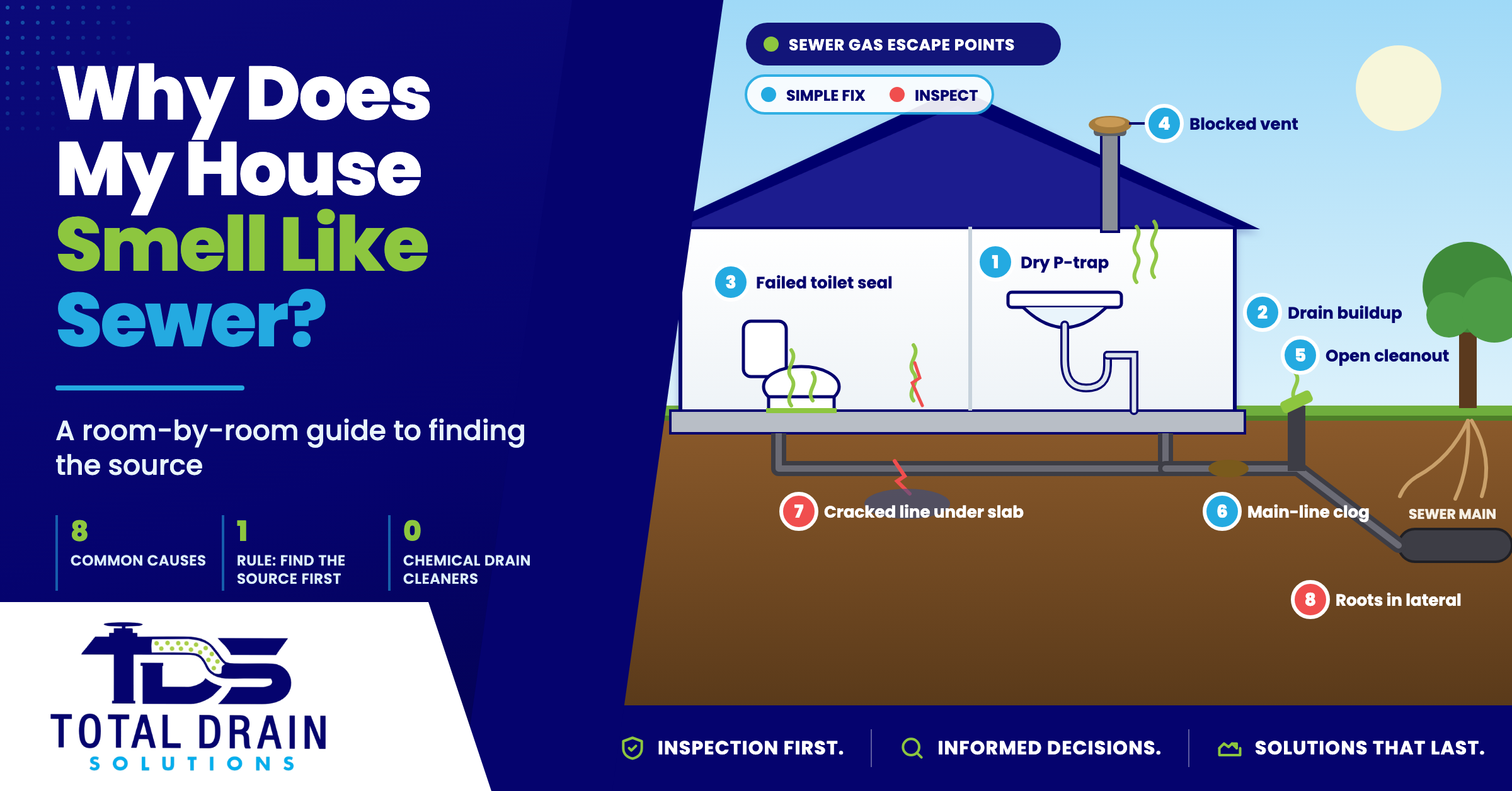
1. A Dry P-Trap
Every drain in the house connects to the sewer through a U-shaped section of pipe called a P-trap. The water sitting in that bend is what blocks sewer gas from coming back up the drain. If the water evaporates, the seal is gone and the drain becomes an open vent into the sewer system.
Dry traps are the most common cause of a sewer smell in a single room, and they are overwhelmingly a problem of fixtures that do not get used: a guest bathroom, a laundry sink, a garage or utility-room floor drain, a shower in a seasonal home. In Las Vegas and Henderson, the dry climate can empty a trap in a matter of weeks. In Florida, the same thing happens in vacation homes that sit closed through the summer. The fix is to run water into the drain for a minute or two. If the smell returns quickly, something else is going on. We cover the desert version of this problem in detail in our guide to why drains dry out in Las Vegas homes.
2. Biofilm and Buildup Inside the Drain Itself
Sometimes what smells like sewer gas is the drain, not the sewer. Hair, soap, toothpaste, skin oils, and food waste form a bacterial film on the inside of drain pipes, the underside of sink stoppers, the overflow channel behind a bathroom sink, and the splash guard of a garbage disposal. That film produces a sulfurous odor that is easy to confuse with sewer gas, especially when it is disturbed by running water.
The tell is that the smell is strongest right at the drain opening and gets stronger when water runs, then fades. Cleaning the stopper, flushing the overflow, and scrubbing the disposal often solves it. A drain that keeps smelling despite that, or that is also draining slowly, usually has buildup farther down the line. That is where professional drain cleaning or hydro jetting comes in. Please skip the chemical drain cleaner. It rarely removes established biofilm and it can damage older pipe. We explain why in our article on reasons to avoid off-the-shelf chemical drain cleaners.
3. A Failed Toilet Seal
A toilet sits on a wax or rubber gasket that seals the base of the bowl to the drain flange in the floor. When that seal fails, sewer gas escapes at the floor line every time the room is quiet, and small amounts of water can seep out with each flush. Seals fail when a toilet rocks on an uneven floor, when the flange has corroded or cracked, when the floor was tiled without resetting the toilet, or simply with age.
Signs point to this cause when the smell is strongest at the base of the toilet, the toilet moves when you push on it, or there is discoloration, softness, or staining in the flooring around it. The repair is usually straightforward, but a flange that has corroded away, common with older cast iron, may need more than a new gasket.
4. A Blocked, Disconnected, or Failed Vent
Your drain system is also a vent system. Every fixture is connected to vent piping that runs up through the roof so that sewer gas can escape above the house and so that air can enter the system as water drains. If a vent is blocked by a bird’s nest, leaves, or debris, or if a vent connection has separated inside a wall or attic, two things happen. Gas that should exit through the roof finds another way out, and draining water can siphon the water out of nearby traps, creating the dry-trap problem all over again.
Vent problems tend to produce a smell that is not tied to one fixture, along with gurgling and slow draining in several fixtures at once. Homes that use air admittance valves under sinks instead of a roof vent have another failure point: those spring-loaded valves wear out and can stick open, letting sewer gas out under the vanity. If your smell is strongest inside a sink cabinet, check for one.
5. A Missing or Damaged Cleanout Cap
Cleanouts are the capped access points on your drain system, usually located near the foundation outside, in a garage, or in a utility area. A cap that has cracked, been knocked loose by a mower, or was never replaced after a service call is a direct opening to the sewer. If your sewer smell is strongest outdoors, near the house, or in the garage, walk the perimeter and find your cleanouts. Our guide to what cleanouts and access points are and how they work will help you recognize them.
6. A Partial Blockage in the Main Line
When the main drain line that carries everything out of the house is partly blocked, wastewater backs up, sits, and decomposes in the pipe. Gas builds up behind the blockage and pushes back through the path of least resistance, which is usually the lowest drain in the house or a trap that has been siphoned dry. The classic pattern is a toilet that gurgles when the shower or washing machine drains, a floor drain or tub that backs up, and a sewer odor that gets worse over days or weeks.
This is not a single-drain problem, and a plunger or a small hand auger will not reach it. The blockage needs to be located and cleared, and the pipe needs to be looked at afterward to understand why it clogged. Grease, scale in older cast iron, roots, or a belly in the line each call for a different long-term answer. Our comparison of hydro jetting vs. snaking for drain cleaning explains how the clearing method is chosen, and our Sarasota drain cleaning and Las Vegas drain cleaning pages cover what to expect locally.
7. A Cracked or Corroded Drain Line Under the Slab or Behind a Wall
This is the cause nobody wants, and it is more common in Florida and Las Vegas than most homeowners realize. Both markets are built almost entirely on concrete slabs, which means the drain lines run under the floor. Many Florida homes built before the mid-1970s were plumbed with cast iron drain lines, and cast iron corrodes from the inside out as it ages. Once the pipe wall is compromised, wastewater leaks into the soil under the slab and sewer gas migrates up through cracks, expansion joints, and the openings around plumbing penetrations.
The smell in this case is often diffuse and persistent rather than tied to a fixture. It may be worse in one area of the house, may come and go with temperature and air pressure changes, and is sometimes accompanied by a damp spot, a warm spot on the floor, cracked tile, or, in more advanced cases, a floor that has begun to settle. There is no visual way to confirm this from above the slab. A sewer camera inspection is how the pipe condition gets documented, and our article on why cast iron pipes need eventual replacement explains what technicians look for.
8. A Damaged Sewer Lateral in the Yard
The sewer lateral is the pipe that runs from the house to the municipal main under the street. Roots, soil movement, a displaced joint, or a crack in that pipe can let gas and wastewater escape into the yard. Clues are a sewer smell that is stronger outside than in, a patch of grass that is greener or softer than the rest, soil that stays wet in dry weather, or insects and pests congregating in one spot. Laterals are also where a partial main-line blockage often originates. Our guide on whether it is time to replace your sewer line covers the warning signs and what the camera has to show before replacement becomes the recommendation.
Less Common Causes Worth Ruling Out
- The smell comes only from hot water taps. That is almost never sewer gas. Certain bacteria react with the anode rod in a water heater to produce hydrogen sulfide in the hot water itself. It is a water heater issue, not a drain issue.
- A washing machine standpipe or utility sink that is rarely used. Same dry-trap problem, different location. Run water into it.
- A septic system. Some Florida homes outside municipal sewer service are on septic. A full tank, a failing drain field, or a vent issue on the tank can produce odors inside and out. Septic service is a separate trade, but a camera inspection of the line from the house to the tank can still show whether the house side is the problem.
- A sump or ejector pit. Rare in Florida and Nevada homes, but if you have one, a missing or unsealed lid is a common odor source.
Sewer Smell vs. Mold or Mildew Smell
Not every unpleasant odor is sewer gas. Musty, earthy, or damp-cardboard smells generally point to mold or mildew, which in Sarasota usually means a moisture problem and sometimes a hidden plumbing leak feeding it. Sewer gas is sharper, more sulfurous, and closer to rotten eggs. The two can coexist, since a leaking drain under a slab creates both moisture and gas, but they are different problems with different fixes. If you are unsure which one you are dealing with, our guides to what mold smells like in Sarasota homes and what mildew smells like and how to trace it will help you tell them apart.
Florida and Las Vegas: Same Smell, Different Usual Suspects
Total Drain Solutions works in two very different climates, and the odor complaints we see in each one skew differently.
Sarasota and Southwest Florida
Humidity, a high water table, salt air near the coast, and a large stock of pre-1980 homes with cast iron drains make corroded and cracked drain lines a leading cause of persistent sewer odor here. Heavy rain during the wet season can saturate the soil around a compromised lateral or push gas up through a slab that already has a leak beneath it. Seasonal residents also return in the fall to dry traps and, occasionally, to a problem that has been developing all summer. For homes in Sarasota, Bradenton, and Venice, a camera inspection is often the fastest way to separate a maintenance issue from a structural one.
Las Vegas and Henderson
In the desert, evaporation is the first suspect. Traps dry out quickly, especially in guest bathrooms and in homes that sit empty during the summer. Hard water is the second. Mineral scale narrows drain lines over time and gives grease and debris something to cling to, which leads to the slow-building main-line blockages described above. Slab construction is universal here too, so an older home with a persistent, diffuse odor still deserves a look at the pipe under the floor. Our Las Vegas sewer camera inspection and Henderson pages cover local service. If your inspection uncovers damage, see our guide to reviewing your sewer camera footage before authorizing repairs in Las Vegas.
What a Professional Odor Diagnosis Looks Like
When a homeowner has done the walk-through above and the smell persists, the professional process at Total Drain Solutions moves in a specific order. The goal is to arrive at the source with evidence rather than to start replacing parts.
Step 1: Trace the Odor and Eliminate the Simple Causes
A technician will confirm which fixtures and areas are affected, check trap seals, inspect toilet bases and flanges, look for air admittance valves, verify that cleanout caps are intact, and check accessible vent piping. A surprising share of odor calls end here.
Step 2: Camera Inspection When the Source Is Inside the Pipe
If the symptoms point to the drain lines themselves, a sewer camera inspection documents what is actually happening inside the pipe: buildup, scale, root intrusion, corrosion, cracks, offset joints, or a belly holding standing water. Our articles on what happens during a sewer camera inspection and the most common problems found during sewer camera inspections show what that footage typically reveals. Where the line is too fouled to see, cleaning may need to happen first so the pipe wall can be evaluated properly.
Step 3: Match the Fix to the Finding
A blockage or heavy buildup points to drain cleaning, hydro jetting, or mechanical cleaning for scale in cast iron. A localized crack or failed joint may justify a spot repair. Widespread corrosion in a pipe that still holds its shape may be a candidate for trenchless pipe lining, which rehabilitates the line without breaking the slab. A collapsed or badly displaced section may require trenchless sewer repair or targeted replacement. The inspection footage should be the basis for whichever of these is recommended, and you should be able to see it and have it explained.
What Not to Do While You Figure It Out
- Do not mask the smell. Air fresheners and scented drain products hide the symptom and delay the diagnosis.
- Do not pour chemical drain cleaner down the line. It does not fix any of the causes above and it can damage aging pipe.
- Do not seal off a smelling drain. Taping over a floor drain traps gas in the system and moves the problem to the next-weakest point.
- Do not ignore gurgling. Gurgling means air is moving where water should be, and it is one of the earliest signs of a main-line problem.
- Do not assume it will pass. Dry traps pass. Cracked pipes do not.
Quick Reference: Symptom, Likely Cause, First Step
| What you notice | Most likely cause | Reasonable first step |
|---|---|---|
| Smell from one rarely used drain | Dry P-trap | Run water for two minutes; recheck in a day |
| Smell at the drain opening, worse when water runs | Biofilm or buildup in the drain | Clean stopper and overflow; if it persists, professional drain cleaning |
| Smell at the base of the toilet, toilet rocks | Failed toilet seal or flange | Have the toilet reset; check the flange condition |
| Smell under a sink cabinet | Failed air admittance valve or loose connection | Replace the valve; check joints |
| Smell in several rooms plus gurgling and slow drains | Vent blockage or partial main-line clog | Professional drain evaluation and clearing |
| Smell strongest outside or in the garage | Missing cleanout cap or lateral defect | Locate cleanouts; camera inspection of the lateral |
| Diffuse, persistent smell with damp floor, cracked tile, or settling | Cracked or corroded line under the slab | Sewer camera inspection before any repair decision |
| Smell only from hot water taps | Water heater anode reaction | Water heater service, not a drain issue |
Find the Source, Then Fix the Pipe
A sewer smell in the house is a symptom with at least eight common causes, and the fixes range from running a faucet to rehabilitating a drain line under the floor. The order of operations matters. Rule out the simple things, pay attention to where and when the smell shows up, and when the evidence points inside the pipe, get the pipe inspected before anyone proposes a repair.
Total Drain Solutions believes homeowners should see the evidence behind a drain or sewer recommendation. If you have a persistent sewer odor that the basic checks did not resolve, contact Total Drain Solutions to schedule a drain evaluation or camera inspection. We will help you understand what the system is showing and which next steps make sense for your property.
Homeowners along Florida’s Gulf Coast can reach our team through our Sarasota, Bradenton, and Venice service pages. In Southern Nevada, we serve Las Vegas and Henderson with the same inspection-first approach to drain and sewer odor problems.
FAQ: Sewer Smell in the House
A clog is only one of several causes. The most common reason for a sewer smell with normal drainage is a dry P-trap in a fixture that is not used often. Other causes that do not involve a clog include a failed toilet seal, a blocked or disconnected vent, a worn air admittance valve under a sink, a missing cleanout cap, or a cracked drain line under the slab. Start by noting where the smell is strongest and when it appears.
At the low concentrations typical in a home, sewer gas is mainly an irritant that can cause headaches, nausea, and eye or throat discomfort. Hydrogen sulfide, the component you smell, can dull your sense of smell at higher levels, so a fading odor is not proof the problem is gone. Ventilate the area and find the source. If the smell is strong, if you feel dizzy, or if you suspect natural gas rather than sewer gas, leave the building and call your gas utility from outside.
Intermittent odors usually track something in the environment: a trap that dries and refills, air pressure changes when the air conditioning or an exhaust fan runs, a vent problem that only shows up when a large volume of water drains, or a leak under the slab that releases gas as temperature and ground moisture change. Keeping a short log of when the smell appears and what was running at the time is one of the most useful things you can do before a technician arrives.
Heavy rain saturates the soil and can force gas out of a cracked lateral or a leaking line under the slab. It can also raise the water level in a municipal system and push air back through vents and traps. In Florida, where the water table is already high, a sewer smell that reliably follows rain is a strong reason to have the lateral and under-slab lines inspected with a camera.
That pattern usually means the odor is coming from buildup inside the drain rather than from the sewer. Running water disturbs the bacterial film on the pipe walls, the stopper, and the sink overflow and releases the smell. Cleaning those surfaces often solves it. If the drain also runs slowly or the smell returns quickly, the buildup is farther down the line and professional drain cleaning is the next step.
Yes. In slab-on-grade homes, which describe nearly all of Florida and Las Vegas, a corroded cast iron or cracked drain line leaks wastewater into the soil beneath the floor, and the gas migrates up through cracks and joints. The smell is often diffuse and persistent rather than tied to one fixture, and it may be accompanied by a damp spot, a warm spot, cracked tile, or settling. A sewer camera inspection is how that condition is confirmed.
For a toilet seal, a water heater issue, or a fixture repair, a general plumber is the right call. For odors that point to the drain lines themselves, such as gurgling, slow drains in multiple rooms, recurring blockages, or a suspected under-slab or lateral problem, a drain and sewer specialist with camera inspection and cleaning equipment can diagnose and document the source. Total Drain Solutions handles the inspection, cleaning, and trenchless rehabilitation side of that work for residential and commercial properties.
Tags:
Schedule Service
Our Services


Benefit From Our Complete Range of Services Today
At Total Drain Solutions, we get the work done right the first time. Each member of our team works with the highest level of integrity. By using the best technology and processes along with proven craftsmanship, we fully restore your piping system to its original condition. For more information or to get an estimate, contact our team today.